On the ballot November 6, 2018 in the following cities in Alameda and Contra Costa Counties:
Oakland, Alameda, Piedmont, Berkeley, Emeryville, Albany, Richmond, San Pablo, and El Cerrito.
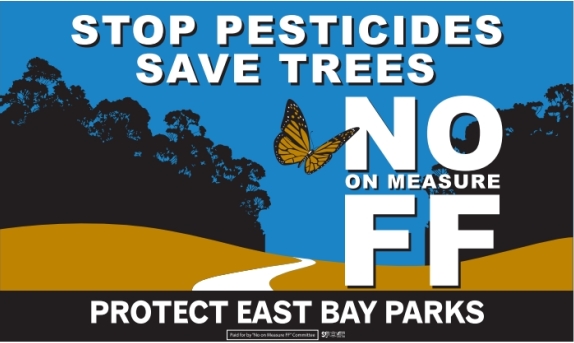
VOTE NO ON MEASURE FF
HELP SPREAD THE WORD:
Yard Signs Available Here, Print Out Flyers Here
Opposition statements:
2018 Voter Handbook Statement in Oppositionby the Forest Action Brigade
Voter Handbook Rebuttal to Arguments in Favorby Peter Gray Scott, architect; Jean Stewart, botanist and former
pesticide researcher; Maxina Ventura, East Bay Pesticide Alert; and Mary
McAllister, webmaster of Million Trees blog
2018 Green Party Alameda County Recommends No, with Reservations
Under the guise of fire safety, several agencies, including the
University of California (UC), the East Bay Regional Park District (EBRPD), and the City of Oakland, are undertaking
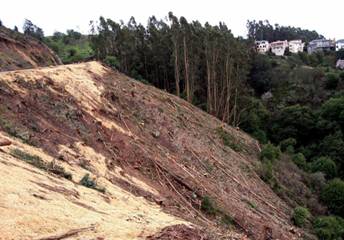
massive clearcutting of the East Bay Hills, involving extensive use
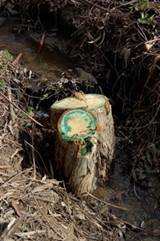
of pesticides. The blue ring around the
edge of the tree stumps in the picture above, is an example
of such pesticide applications running off into the creek at
the base of the stumps.
Are eucalyptus, acacia, and Monterey pines invasive non-native fire
hazards, or carbon sequestering habitat and natural treasures? Do we
want Dow and Monsanto profiting more than they have already with UC's
pesticide use on clearcuts done in the hills over the past decade? Are
our East Bay Lungs being sold off for wood pellets for Europe, biomass
for China's coal plants, toilet paper for Japan, logs for the fracking
industry? Longshore workers confirm wood chips are being shipped out of
West Coast ports.
This compilation of several comments submitted to FEMA's
Environmental Impact Statements in protest of grant applications by
these agencies in 2013, serves
as a good primer for the history and details of these projects (more details about the FEMA fiasco at bottom):
FEMA
comments - compilation (pdf)
For a good overview
of what these agencies have been doing in the East Bay Hills, and the
ideology fueling these destructive activities, in 2015 East Bay Pesticide Alert
/ Don't Spray California, together with the Social Justice Committee of the Berkeley Fellowship for Uniterian Universalists, hosted
an event with Conservation Biologist David Theodoropoulos, Firefigther
David Maloney, Forest Photographer Ken Cheetham, and other local
activists, which can be viewed in its entirety online. You
are welcome to show this video at community gatherings and to contact
us to request speakers on wildfire and pesticides issues:
VIDEO: East Bay Hills Forests: Invasive Fire Hazards or Natural Treasures? July 31, 2015, Berkeley, California
Community discussion of the FEMA-funded tree removal projects in the
East Bay Hills, from Richmond to Hayward, which are opposed by 90% of
the 13,000 comments on FEMA's Environmental Impact Statement. Watch a
fire demonstration by a Firefighter called on by local mayors after the
1991 hills fire,
and a slideshow by Conservation Biologist discussing species migration
and acclimation throughout history.
(00:19)
Host MAXINA VENTURA, Chronic Effects Researcher, East Bay Pesticide Alert, http://www.dontspraycalifornia.org/
(05:14)
DAVID THEODOROPOULOS, Conservation Biologist; Author: Invasion Biology - Critique of a
Pseudoscience; Slideshow Presentation, http://dtheo.org/
(1:09:17) KEN CHEETHAM, Forest Photography; Bay Area Progressive Directory, http://bapd.org/trees.html
(1:23:41) DAVID MALONEY, Retired Oakland Fire Department; Chief, Fire Prevention, Oakland Army
Base; appointed to 1991 Oakland-Berkeley Mayors' Task Force on
Emergency
Preparedness and Community Restoration; Fire Demonstration. Read his 2016 hills fire danger paper
for nuts and bolts wildfire info, and his alternate proposal for the East Bay Hills.
Plus updates from
(1:43:45)
DAN GRASSETTI, Hills Conservation Network, http://hillsconservationnetwork.org/
(1:55:39) TANYA SMITH, Forest Action Brigade
(1:57:46) JACK GESCHEIDT, TreeSpirit Project http://treespiritproject.com/
For more information also check out:
Death of a Million Trees http://milliontrees.me/
Save the East Bay Hills http://www.saveeastbayhills.org/
Save Mount Sutro Forest http://sutroforest.com/
San Francisco Forest Alliance http://sfforest.org/
Save Our Dimond Park Trees https://www.facebook.com/SaveOurDimondParkTrees/
GET INVOLVED: Sign up for Alerts and get involved with the Coalition to Defend East Bay Forests
http://defendeastbayforests.wordpress.com/
Both the Sierra Club and Claremont Canyon Conservancy, which are
actively promoting the downing of nearly half a million East Bay Hills
trees (Sierra Club is even suing FEMA to demand that more trees are
killed faster), were invited to participate on a panel of both
proponents and opponents of these projects. Neither organization
responded to East Bay Pesticide Alert's invitation.
Also available in the series of useful videos on this issue is our previous event in 2013:
VIDEO: Invasion Biology or Integration Biology? July 14, 2013, Berkeley, California
What's the connection between the "native plants restoration
movement"and the pesticide industry? Who is behind the deforestation and pesticiding of the East
Bay Hills, killing over 486,000 trees from Richmond to Hayward, and
doing the same to San Francisco’s beautifully forested Mt. Sutro? Who benefits from a war on "non-native" species?
San Francisco Bay Area residents explore these questions
with evolutionary biologist David Theodoropoulos, who debunks the
pseudoscience - and reveals the corporate agenda - driving the "native
plant restoration movement", in a public forum
co-sponsored by East Bay Pesticide Alert / Dont Spray California and
the Social Justice Committee of the Berkeley Fellowship of Unitarian
Universalists –
BFUU.orgPt. 1 – Introduction with Maxina Ventura, East Bay Pesticide Alert,
DontSprayCalifornia.orgMadeline Hovland,
HillsConservationNetwork.orgRupa Bose,
SaveSutro.com (Slideshow of cloud forest)
Pt. 2-A – First half of David Theodoropoulos’ Presentation (Slideshow of normal migration activity of species over time)
Pt. 2-B – Second half of David Theodoropoulos’ presentation
Pt. 3 – Closing remarks with Maxina Ventura, East Bay Pesticide Alert,
DontSprayCalifornia.orgConnie Barker, Environmental Health Network,
EHNCA.orgSteve Jacobson,
EarthFirst.orgMarg Hall, Communities United in Defense of Olmstead,
CUIDO.orgDiscussion with David Theodoropoulos,
DTheo.orgRecorded by EON, and also posted on the
Planetarian Perspectives Blog
SOME HISTORY OF WILDFIRE PROJECTS IN THE EAST BAY HILLS
David
Theodoropoulos points to the historic involvement of the pesticide
industry in establishing
invasive
species councils to do their bidding, and shows photos
of eucalyptus in the Oakland hills during the 1991 fire, in
areas where the understory had been kept down.
We have seen repeatedly that native plant restoration projects are
being masqueraded as wildfire prevention projects and more insidiously,
taxpayer self-assessments along with tax-supplied grants are being sold
to taxpayers as necessary for wildfire safety. We heard ad nauseum from
the East Bay Regional Park District (EBRPD) about their fixation with getting rid of what they
refer to as non-native plants. But Invasion Biologists have differing
scientific opinions on when species have reached acclimation, at which
point even trying to remove them can pose biological danger.
EBRPD claims that "Invasive plants are harmful, non-native plants" and
"Invasive species have no natural enemies in the environment". These
are irrational, and just plain inaccurate claims. Species become
naturalized. Some native plants can be quite invasive. Many predator
species are generalists who'll eat just about anything. The irony of
largely European descendents and other pilgrims to this country,
vilifying "invasive", "non-native", "exotic" species, and claiming that
native species must be defended from them by dumping toxics everywhere
and killing living things, is not lost on immigrants and indigenous
people alike.
Under the guise of protecting the hills from supposed fire danger from
non-native, so-called "invasive" species, these projects in fact
threaten the biodiversity and native ecology of the hills. While
suppressing fires in specific situations can save lives, preventing
wildfires in a wildfire zone dooms fire-dependent
species, which have evolved there, to extinction.
Wildfire areas, by definition, are potential habitat of fire-dependent
species. Pallid Manzanita is native to our East Bay Hills, has evolved
there, is listed as an endangered species, and cannot exist naturally
without wildfire. As such, wildfire prevention in and of itself,
regardless of the methods, has significant impacts on all
fire-dependent species, and represents a threat to their continued
existence. Wildfire prevention is not a sustainable or ecologically
sound practice.
The
agencies that are deforesting the East Bay Hills have been spending
years filing for government approval, and grants from various sources
to accomplish their goals:
EAST BAY REGIONAL PARK DISTRICTIn 2009 the EBRPD prepared a Final Environmental Impact Report for Wildfire
Hazard Reduction and Resource Management, contributing further to the
use of toxics and deforestation in our hills:
EBRPD Environmental Impact Report for Wildfire Hazard Reduction and Resource Management (July 2009)
EBRPD
Wildfire Plan (July 2009)
EBRPD Wildfire EIR
public comments regarding herbicide flammability testing, provided by Cheriel
Jensen of Protect Our Valley, Saratoga, CA
EBRPD Wildfire EIR comments submitted by East Bay Pesticide AlertUNIVERSITY OF CALIFORNIAThe
University of California, Berkeley also prepared an Environmental
Impact Report for its 2020 Long Range Development Plan, in 2005, which
includes its plans for fire fuel management. Its plans have been slowed
by legal action by the Hills Conservation Network, a group of East Bay
Hills residents, supported by community funds throughout the Bay
Area and beyond:
UC Berkeley Fire Fuel Managment ProgramUC Berkeley 2020 Long Range Development Plan Environmental Impact Report (2005)
The Hills Conservation Network has posted overviews of the UC Berkeley
projects, and pointed to concerns that UC's clearing of land may be
done
only under the guise of fire mitigation, with the real reason to make
room for the Lawrence Berkeley National Laboratory expansion:
Overview
of UC Berkeley's Fire Mitigation Program at Strawberry Canyon
Map
of proximity of UC's project to Lawrence Berkeley National Laboratory
Maps
of UC and EPRPD fire programs in the East Bay Hills
UC is also involved in a similar toxic logging
project in San Francisco, where 30,000 trees are on the chopping block on Mount Sutro:
Save Mount Sutro Forest
UC has a longstanding relationship with pesticide companies, such as
Novartis, and now retired Tom Klatt, the Manager of the UC Berkeley Office of
Emergency Preparedness, has steadfastly urged agencies and cities to use
pesticides in the East Bay Hills. The latter was widely exposed in 2005
when both Tom Klatt, and Nancy Brownfield, EBRPD IPM Specialist, were
urging the City of Oakland to add yet another exemption to the
Oakland's
sham of a pesticide ban, and use pesticides on the 1,000+
acres it oversees in the city's
Wildfire
Prevention Assessment District. Unbeknownst to us, while city
officials were seemingly backing off their contested plans, they were
quietly preparing to collaborate with UC Berkeley in an extensive "Fire
Mitigation Program", contributing financially to a project that
apparently violates the city's own
regulations:
UC
Berkeley's Fire Mitigation Program 2005 Annual Report (pdf)
CITY OF OAKLANDAs of 2018, the City of Oakland is in the process of
producing a Vegetation Management Plan and Environmental Impact Report
focused on the East Bay Hills:
Oakland Vegetation Management Plan and Environmental Impact Report
This
EIR has been planned since 2005, when the City of Oakland, with the
support of representatives of UC
Berkeley and the East Bay Regional Park District,
proposed the use of
Roundup (glyphosate) and Garlon (triclopyr) for wildfire prevention. At
the time, we provided all representatives with copies of
toxicological profiles for these two pesticides, outlining their
dangers to human health and ecology.
In addition to these two pesticides, the following links are to toxicological information of some of the
pesticides
mentioned in the EBRPD Fire Plan:
TOXICOLOGY
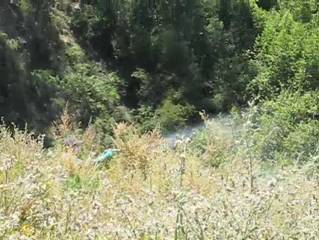
Pesticide being sprayed in the EBRPD
Triclopyr
Toxicological Profile (Garlon) (pdf)
Glyphosate
(Roundup) Toxicology
Clopyralid
Toxicological Profile (pdf)
Dicamba
Toxicological Profile (pdf)
Additionally, as witnessed on
UC
pesticide notification signs, imazapyr may also be
used as part of their project:
Imazapyr
Toxicological Profile (pdf)
The pesticide use of these supposed fire prevention projects, is in
addition to routine pesticide use by the EBRPD IPM Program:
EBRPD
2008 Annual Pesticide Report (pdf)
All of these pesticides also contain so-called "inert" ingredients,
which are kept undisclosed, protected as "proprietary" by trade secret
laws, are frequently even more toxic than the "active" ingredients
listed on the label, and are specifically designed to interact
synergistically to achieve greater toxicity than each chemical by
itself.
Unidentified
Inert Ingredients in Pesticides: Implications for Human and
Environmental Health - Cox and Surgan (pdf)
The
Impacts of Chemical Mixtures - Our Stolen Future
Synergism
by Ingrid Pollyak (pdf)
While government agencies and pesticide manufacturers downplay the
importance of synergism, this essay, by a teen who homeschools,
illustrates that understanding synergistic effects
of chemicals does not require a Ph.D.
As can be seen on UC Berkeley's pesticide notification signs, as well
as the UC Berkeley 2005 program report, pesticides are being mixed
together, compounding the dangers.
The dangers of chemical exposure are commonly downplayed with
statements that the quantities of their poison are miniscule, with
pesticide manufacturers and legislators going to great lengths to agree
on just how much poison is legally acceptable to let loose on our
environment. But in addition to synergistic and cumulative effects of
chemical mixtures, some chemicals have a "nonmonotonic" dose-response,
where reducing the dose of the chemical does not result in a reduction,
but an increase in toxic effects.
The
Low Down on Low-Dose Endocrine Disruptors (pdf)
Each
of these projects is only one of many more, several adjacent to each
other, and only together is it possible to get a full understanding of
the devastation they would cause:
Overview
of some of the Fire Programs in the East Bay Hills
A Million Trees
Reports on deforestation projects around the Bay Area, including
clearcutting under the guise of fire prevention
Rather than contribute to greater public safety, these fire plans
actually add greater hazards, including damaging health effects from
pesticide exposure on park workers, visitors, and wildlife. Concern
about such pesticide exposure on EBRPD lands has been expressed by
AFSCME
Local 2428, the union of the East Bay parks workers, in their
opposition to the
LBAM
Program. Additional hazards include erosion and mudslides
from cleared land, as well as greater fire danger from dying, dry
vegetation resulting from the use of herbicides, and flammability of
the chemicals themselves.
FEDERAL EMERGENCY MANAGEMENT AGENCY GRANT APPLICATIONS
In 2015 FEMA produced an Environmental Impact
Statement, under the federal NEPA program (the equivalent of CEQA for
the State of California, but on the national level), for the combined
projects by UC Berkeley, the East Bay Regional Park District, and the
City of Oakland, in response to simultaneous grant applications. In
these plans it was revealed that about half a million trees in the East
Bay Hills are on the chopping block. Over 13,000 comments were
received, 90% of them opposed to the projects.
FEMA East Bay Hills Hazardous Fire Risk Reduction Final Environmental Impact StatementEast
Bay Pesticide Alert / Don’t Spray California’s Fall opposition
response to FEMA grant requests by UC; East Bay Regional
Park District; and the city of Oakland for funds for what these
agencies call ‘wildfire prevention projects’ which are, once again,
‘native plant restoration’ projects. This is a good overview of the
relationship between tree decimation and pesticide use:
East Bay Pesticide Alert FEMA comments (2010) (pdf)
FEMA
comments - compilation
(2013) (pdf) Compilation of comments by East Bay Pesticide Alert, Isis
Feral, Mary McAllister, Hills Conservation Network, Bev Jo, and CUIDO
(Communities United In Defense of Olmstead)
The Next Major Fire in the East Bay Hills, by David Maloney,
is a description of what the next fire in the hills would look like if
the FEMA projects were granted, by a retired Oakland firefighter, and
former Chief of Fire Prevention at the U.S. Army Base in Oakland, who
was appointed to the
Oakland-Berkeley Mayors’ Firestorm Task Force
(also known as the 1991 Emergency Preparedness and Community
Restoration Task Force), which deternined that houses were the primary
cause of the spread of the 1991 Oakland Hills Fire.
If You're Afraid of Trees, Don't Live In a Forest,
by Isis Feral, gives an overview of some of the history that lead to
the FEMA EIS, written on the 25th anniversary of the 1991 fire (October
2016, Slingshot)
Key points of the opposition statements by the
Death of a Million Trees blog, and the Hills Conservation Network,
summarize the details of these projects:
Death of a Million Trees blog:Nearly a HALF MILLION trees will be destroyed if these East Bay projects are approved (May 9, 2013)
These projects are more likely to increase the risk of wildfires than
to reduce that risk.
- By
distributing tons of dead wood onto bare ground
- By
eliminating shade and fog drip which moistens the forest floor making
ignition more likely
- By
destroying the windbreak that is a barrier to wind driven fires typical
of wildfires in California.
- By
expanding the oak-bay woodland being killed by Sudden Oak Death,
thereby adding more dead wood
These projects will
damage the environment by releasing hundreds of thousands of tons of
carbon dioxide into the atmosphere from the destroyed trees thereby
contributing to climate change
- Endangering
the public by dousing our public lands with thousands of gallons of
toxic herbicides.
- Erosion
is likely on steep slopes when the trees are destroyed and their roots
are killed with herbicides.
- Non-native
vegetation such as broom, thistle, and hemlock are more likely
occupants of the unshaded, bared ground than native vegetation which
will not be planted by these projects.
- Prescribed
burns will pollute the air and contribute to the risk of wildfire,
endangering lives and property.
These projects are
an inappropriate use of the limited resources of the Federal Emergency
Management Agency which are for the express purpose of restoring
communities destroyed by disasters such as floods and other
catastrophic events and preparing communities for anticipated
catastrophic events. Most of the proposed projects in the East Bay are
miles away from any residences.
The
Hills Conservation Network objected to the EIS on the basis
of the following arguments, and later won a challenge in court
challenging the EIS, which resulted in the denial of the grants for UC
Berkeley and Oakland, and only the grant for the park district
remained, because it was supposed to fund only brush clearing and not tree removal:
- The FEMA
Draft EIS for UC, Oakland, and EBRPD vegetation management projects in
the hills is unacceptable because is does not meet its own stated goal
of reducing flame lengths to 2 feet. The proposed treatments will
result in an environment with flame lengths of between 14 feet and 69
feet, based on the same data set that was used to construct the EIS.
This flame length is worse than what could be expected with the trees
that exist currently. We ask that you retract the EIS and rework it to
develop a proposal that actually fixes the problem.
- The FEMA
Draft EIS for UC, Oakland, and EBRPD vegetation management projects in
the hills is unacceptable because it does not adequately address the
effects of these projects on Greenhouse Gas emissions and the ongoing
reduction in carbon sequestration capacity. The analysis not only uses
an inappropriate baseline, but also fails to adequately consider the
loss of ongoing carbon sequestration that will result from these
projects. We ask that you retract the EIS and rework it to fully
consider all the Greenhouse Gas implications of cutting down 100,000
tall trees.
- The FEMA
draft EIS for UC, Oakland, and EBRPD projects is unacceptable as
currently written in that it does not adequately address the cost or
the risks associated with the herbicide use that is being proposed. We
ask that you retract the EIS and rework it to fully consider all the
implications of the expected herbicide use not only to kill eucalyptus
trees, but also the hemlock, broom, thistle, and poison oak that will
emerge as a result of the loss of shade canopy.
- The FEMA
Draft EIS for UC, Oakland, and EBRPD vegetation management projects in
the hills is unacceptable because it does not adequately analyze
reasonable alternatives proposed for fire risk mitigation. Far less
costly, far less environmentally damaging, and far more effective
methods have been proposed, but the EIS fails to consider them. The EIS
needs to be retracted and reworked to analyze reasonable alternatives
rather than simply dismissing them without any serious analysis.
- The FEMA
Draft EIS for UC, Oakland, and EBRPD vegetation management projects in
the hills is unacceptable because it does not adequately analyze the
effects on air quality resulting from the proposed plan. We ask that
you retract the EIS and rework it to fully consider all the
implications of the proposed projects on air quality.
- The FEMA
Draft for UC, Oakland, and EBRPD vegetation management projects in the
hills is unacceptable because it relies on a fire model that is
fundamentally flawed in that it compares the risk of the current
environment with the environment that will exist the day after 100,000+
trees are cut. This is a meaningless comparison, as the EIS does not
specify any means by which the project proponents will maintain the
environment in this condition. Because of this, shortly after the
projects are completed the fire danger will begin to increase. We ask
that you retract the EIS and rework it to include a fire model that
analyses the expected end result vegetation rather than an essentially
irrelevant state.
The struggle to stop these toxic, destructive projects is not over, and there's much work to be done.
To get involved visit the
Coalition to Defend East Bay Forests, which we are part of, and sign up for
email alertsSOME OF THE GROUPS OPPOSING THE EAST BAY HILLS PROJECTS:East Bay Pesticide Alert (toxicology of pesticides, and history of this struggle back to 2005)
Save the East Bay Hills (good overview and resources for contacting responsible agencies)
Death of a Million Trees (science relevant to the East Bay hills ecology)
TreeSpirit Project
(Jack Gescheidt's photography, civil disobedience, and science challenging "Invasion Biology")
Bay Area Progressive Directory (Ken Cheetham’s hills photography, scientific citations of key arguments against these projects)
Hills Conservation Network (more historical documentation, legal action)
Forest Action Brigade (organized protests against Sierra Club involvement in projects)
Communities United in Defense of Olmstead (CUIDO) (disability rights group, organized protests at UCB in defense of hills forests as an access issue)
Contra Costa Citizens 4 Eucs (Contra Costa County group, outraged by removal of eucalyptus trees from the hills)
Save Mount Sutro (San Francisco allies, defending the forest on Mount Sutro)
San Francisco Forest Alliance (San Francisco allies, defending San Francisco forests)
Page
last updated 10/18/2018 (please search any dead links in
WayBackMachine or
contact us to locate missing information)